Akash
Background research: knowledge sharing today, barriers to year-round learning, the eleven options (slides 6–8). Risk register.
Who the Lama Lama Rangers are, and why time together on Country is the constraint this project addresses.
Contributions of each member of David’s Friends to this website, agreed by the team.
Background research: knowledge sharing today, barriers to year-round learning, the eleven options (slides 6–8). Risk register.
Decision matrix and option selection, the proposed pathway, the four stages (slides 9–12). Website design and build.
Feasibility and alignment criteria, working with Yintjingga (slides 13–15). Community concerns.
Acknowledgement of Country, project context, the design question, the two Ranger programs (slides 1, 3–5). Executive summary and reference list.
Sustainability and clarity criteria, the prototype concept and test method (slides 16–18). Journey map.
Implementation, costing and funding, the conclusion (slides 19–21). Website design and build; recommendations.
Slide numbers refer to the team presentation. The website was designed and built by Rishi and Louis; all members contributed to review and editing.
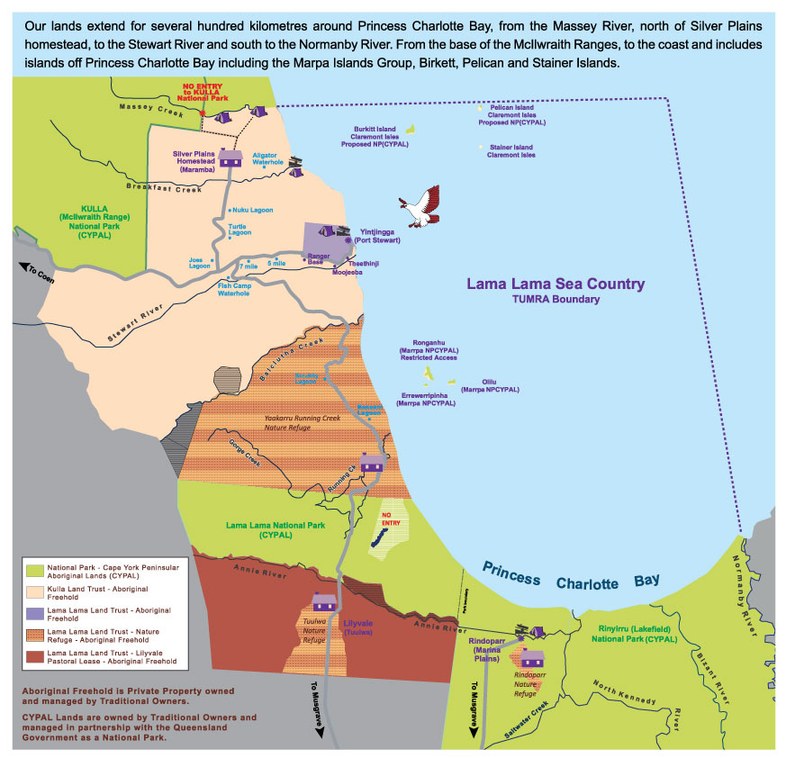
The Lama Lama People are the Traditional Owners of the land and sea Country around Princess Charlotte Bay on the east coast of Cape York Peninsula, Queensland. Port Stewart is the community at the centre of this project (Figure 2).
The Yintjingga Aboriginal Corporation (YAC) coordinates both Ranger programs and holds quarterly community meetings. Any change runs through YAC and the Elders, who hold the authority to decide what knowledge is shared and with whom. This proposal responds to Design Area 4 — Augmenting the Ranger Program.
Both programs run today. What is missing is a route from one to the other.
Three activities carry knowledge between generations, all needing Elders, Rangers and Junior Rangers on Country at once.
Flora and fauna surveys, where Junior Rangers learn species, seasons and sites alongside Rangers.
Cultural programs and camps that bring Elders and young people together on Country.
Traditional burning and gatherings, where knowledge is shown and used, not only described.
Ranger programs combine traditional knowledge with conservation training to protect Country and Culture.
NIAA, 2022, p. 7
These work when they run. The difficulty is how rarely they can, and how little connects one occasion to the next.
Roads close and sites become unreachable from mid-November to April. Cyclones damage Ranger bases and reset the year’s plans.
When budgets go to recovery and repairs, there is less Ranger time left for mentoring.
Junior Rangers can only join during school breaks, so learning comes in short bursts with long gaps between.
Cyclone Trevor severely damaged the Silver Plains and Port Stewart Ranger bases. Lama Lama Rangers coordinated clean-up and reorganised the year’s operations.
NIAA, 2022, p. 29
The gap: everything depends on shared time on Country, but nothing carries a young person’s learning across the gaps, and nothing shows them what comes next.
We acknowledge the Lama Lama People as the Traditional Owners of the land and sea Country around Princess Charlotte Bay, where this project is based, and pay our respects to Elders past and present. We also acknowledge the Gadigal people of the Eora Nation, on whose land UTS stands and where this work was produced.