Year calendar
Seasons, school holidays, blocks with backup dates, and the YAC review.
What was prototyped and why, how it was made, and the test designed to check it.
The pathway cannot be prototyped without the community. The progress record can.
It is the only component a young person handles, and its failure mode is testable by a stranger: if someone cannot read the sheet and say what happens next, the design fails the clarity criterion. Paper was chosen over any digital tool because connectivity at Port Stewart is unreliable.
The best Ranger tools work offline and need minimal training.
Engineers Without Borders Australia, 2026, p. 38
Version 0.1 is one A4 sheet, printed in colour on an ordinary office printer.
Drafted on paper, then set at A4 with each stage panel sized for three tasks, a day count and two signature boxes. It was filled in by hand as a worked example so a reader sees it in use rather than blank (Figure 5).
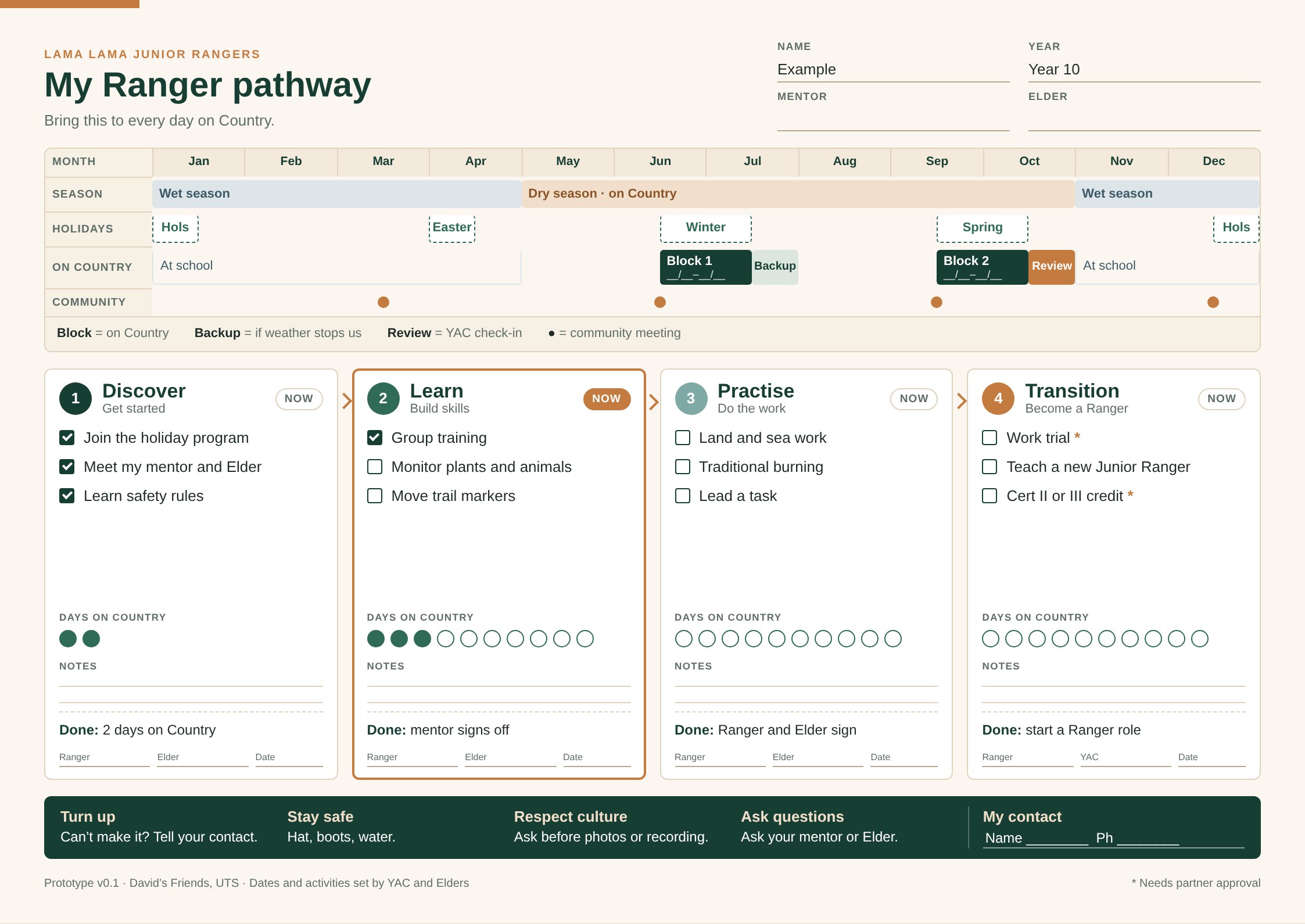
Seasons, school holidays, blocks with backup dates, and the YAC review.
Three tasks to tick, days to fill in, notes, and two sign-offs.
Turn up, stay safe, respect culture, ask questions, and a named contact.
Trials and credit marked as needing approval.
Hand the sheet to someone with no explanation, then ask five questions.
Giving no introduction is deliberate: on Country the sheet is often read without an adult beside it. Responses are timed and anything misread is circled. Participants would be Junior Ranger-aged, arranged through YAC.
The walk-through has been designed but not run, so no results are claimed and v0.1 is unmodified.
Testing with Junior Rangers needs YAC consent and ethics approval the team does not hold; approaching young people without it would breach the cultural authority this proposal depends on. The method is therefore specified here for YAC to authorise.
Replace with results once the walk-through has run. Record:
Photographs and marked-up sheets go in Appendix 5.
Running this test before the pilot is listed as a recommendation in Section 7.2.
We acknowledge the Lama Lama People as the Traditional Owners of the land and sea Country around Princess Charlotte Bay, where this project is based, and pay our respects to Elders past and present. We also acknowledge the Gadigal people of the Eora Nation, on whose land UTS stands and where this work was produced.